
Homework is meant to help children practise what they learn in class. For many families, it has become the most stressful part of the day. Parents face delays, tears and arguments over a single worksheet. Children feel tired and misunderstood. This pattern is common in homes with primary and middle school children.
Parents who look for homework help usually want two things. They want to support their child with patience. They also want to protect the relationship they share with their child.
Teachers observe one point again and again. Homework resistance is rarely about laziness. It is rarely about defiance. It usually comes from fatigue, emotional overload and skills that are still developing. When parents understand this, they can respond with calm instead of conflict.
This guide offers practical homework help for use at home. It explains why children struggle with homework. It then gives six steps to prevent battles, seven ways to help a child who is stuck and advice for each age group. It also answers the questions that parents ask most often.
Quick Answer: 5 Golden Rules of Peaceful Homework
Good homework help at home is calm, predictable and small in size. These five rules form the base.
- Let your child rest first. Give 20 to 30 minutes after school before any book is opened.
- Make the first step very small. Ask your child to open the bag. Do not ask for the full worksheet.
- Coach your child. Do not manage the work. Ask guiding questions. Do not give quick answers.
- Use a visual timer. Let the timer track the time. You do not have to.
- Set a time limit. Close the book when frustration takes over.
Each rule has a clear reason. The next section explains the causes behind homework struggles.
Why Children Resist Homework ?
Understanding the cause makes every other step easier. A parent often sees a child who refuses to work. A teacher sees a child whose mind has been full since morning. Three causes explain most homework struggles.
Gaps in Executive Functioning
Executive functions are the mental skills that help a child plan, focus and remember instructions. They also help a child move from one task to another. These skills develop slowly. Most children are still building them in middle school.
Two gaps appear most often at homework time.
Task initiation. Starting a task is the hardest part. A child must stop a pleasant activity. The child must then begin an effortful one. This change takes a great deal of mental energy. A child may stare at the page for many minutes. This is not refusal. The child cannot find the starting point.
Time blindness. Young children find it hard to judge time. Ten sums can feel endless to an eight-year-old. The child is not exaggerating. The child truly cannot judge the effort.
Fear of Mistakes and Perfectionism
Some children dislike being wrong. Others worry about their handwriting. Many feel lost when a school method looks different from the one a parent learned. Each worry drains energy. When energy is low, a child cries or shuts down.
Mental Fatigue After School
A school day asks a child to sit, listen and follow rules for nearly seven hours. By the evening, the child’s self-control is spent. Psychologists call the release that follows restraint collapse. Home is the safe place. The strain of the day therefore appears at home.
For this reason, tears at the homework table are rarely about the worksheet alone. They reflect the whole day. The most effective homework help begins before the homework does.
6 Proactive Steps to Prevent Homework Battles
Prevention works better than repair. These six steps reduce conflict before it starts.
Step 1: Build a Fixed Launch Routine
Children feel secure when the day follows a clear order. Set one order for the afternoon and keep it.
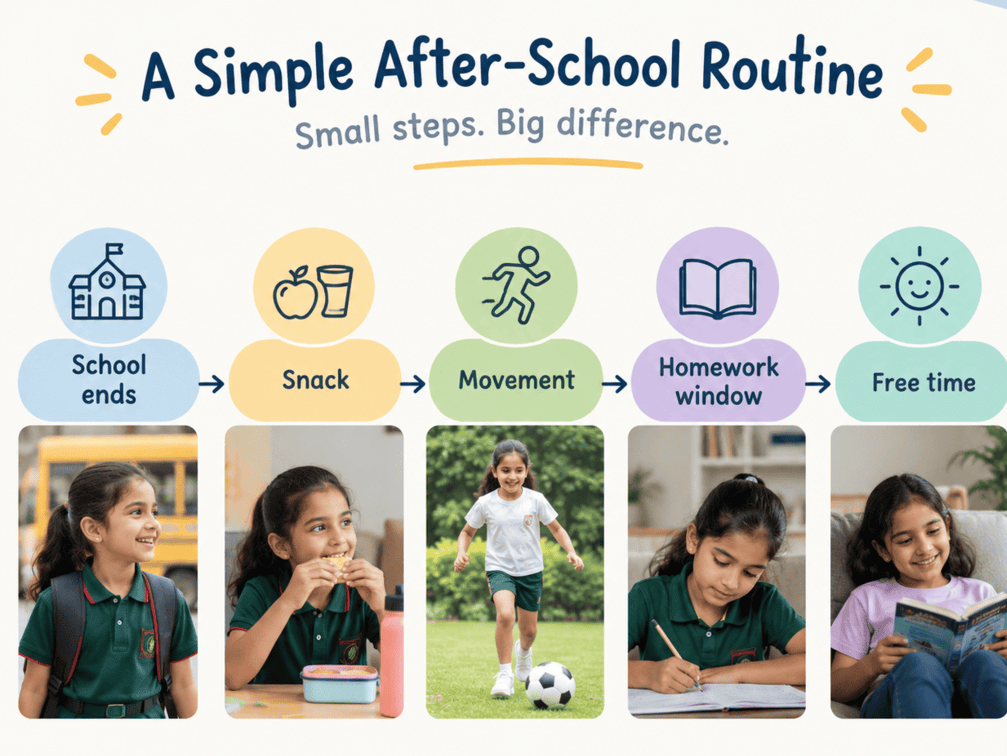
A fixed order removes the daily debate. Your child no longer asks when homework will begin. The routine gives the answer. Each stage also has a clear purpose. A snack restores energy after a long school day. Movement releases the restlessness of sitting in class. By the time homework starts, your child’s mind is ready to focus.
Step 2: Offer Controlled Choices
A routine gives your child stability. Choices give your child a sense of control. Children need both. They follow instructions all day at school. At home, they want a small voice in their own work.
Offer choices on small matters. Keep the task itself fixed.
- “Would you like to start with spellings or reading?”
- “Would you prefer the table or the floor with a clipboard?”
- “Shall we use a blue pen or a green pen today?”
Every option leads to the same work. Your child feels respected. The power struggle fades.
Step 3: Prepare a Low-Friction Study Spot
Choice works best in a space that is ready. A good study spot is quiet and well lit. It is also free of screens.
Keep a homework box nearby. Fill it with sharpened pencils, erasers, a ruler, highlighters and sticky notes. Your child then spends no time searching for supplies. Each search breaks concentration.
Keep phones, tablets and gaming devices in another room. Switch off the television during homework time. Nothing should compete for your child’s attention.
Step 4: Sit Nearby. Do Not Stand Over Your Child.
Many parents watch every line over the child’s shoulder. This raises anxiety. A child who feels watched fears each mistake.
Sit near your child instead. Work quietly on a task of your own. You could read a book, plan the week’s groceries or check household bills. Educators call this body doubling.
Your calm presence gives quiet accountability. Your child feels supported. Your child does not feel judged.
Step 5: Break the Work into Micro-Steps
A full page of questions looks like a mountain to a tired child. Divide the task into very small actions.
- Instead of: “Finish your reading comprehension worksheet.”
- Say: “Take out your pencil and write your name at the top.”
This first step takes ten seconds. Once it is done, the second step feels lighter. The difficulty of starting fades. Momentum then builds on its own.
Step 6: Use Visual Timers
Small steps work better when time is also clear. A visual timer shows time as a shrinking colour block or a falling stream of sand. Your child can see the time pass. The timer becomes the timekeeper. You are freed from the role of enforcer.
Work in blocks of 10 or 15 minutes. Follow each block with a guaranteed break of three minutes. A stretch, a short walk or a glass of water is enough.
7 Ways to Help When Your Child Is Stuck
The six steps above prepare the evening. They cannot remove every difficulty. Sooner or later, your child will meet a question that makes no sense. This is a normal part of learning. What you say at that moment shapes how your child handles the next difficulty. The seven ways below show how to respond.
The guiding rule is simple. Support the thinking. Do not complete the task. Parents who want a closer look at this balance can read our guide on being involved in homework without doing it for your child.
1. Read the Question Together First
Many children are stuck before the work begins. They have read the question but have not understood it. Read it aloud together. Then ask three things.
- “What is this question asking us to find?”
- “What do we already know?”
- “Can you say it in your own words?”
Take this example. A child reads: “Riya has 36 pencils. She packs them in boxes of 4. How many boxes does she need?” Do not say “divide”. Ask what is happening in the story. The child will say that Riya is putting pencils into boxes. Ask what is known. The child will say 36 pencils and 4 in each box. Ask what must be found. The child will say the number of boxes. The hardest part is now done.
2. Return to Class Notes and Solved Examples
Homework reinforces what the teacher has already taught. So a child who is stuck should look back before looking forward. Open the notebook. Find a solved example of the same type. Ask, “Have you seen a question like this in class?”
Then ask your child to explain each step of that example. This reconnects your child with a method that was already practised.
3. Make the Thinking Visible
Some questions are easier when the child can see them. Encourage simple tools on rough paper.
- A drawing or diagram to break a problem into parts
- A table to organise steps or record a pattern
- A number line for addition, subtraction or time
- A bar model to show comparison or parts of a whole
- Rough work to test an idea before writing the final answer
Children rarely use these tools on their own. They need a parent to suggest them. A worksheet may have little space. The thinking still needs room.
4. Allow Five Minutes of Independent Effort
Parents often step in at the first sign of struggle. This is a natural reaction. It also removes a valuable chance to learn. A child who works through a difficulty without quick correction builds patience and confidence.
Set a timer for five minutes. Let your child attempt one question alone. Allow cross-outs and rough notes. If your child pauses, ask only, “What could be your next step?” Acknowledge the effort before any correction. A sentence such as “You are working hard on this” is enough.
5. Ask Your Child to Explain Aloud
When children explain their work aloud, they notice their own errors. Parents also see how the child thinks. This gives more information than a correct answer.
Try these questions.
- “How did you work that out?”
- “What did you do first?”
- “Would this method work for every question or only this one?”
Often, a child says, “I added the wrong number here.” The child has found the mistake without any correction from you.
6. Begin with What the Child Already Knows
A hard question feels easier after an easy one. Start with a question the child can solve. Build up from there.
If the homework contains 56 + 27, ask your child to solve 56 + 20 first. Then add 7. The child practises place value and carrying in two small steps. The full question no longer feels heavy.
7. Praise the Method, Not Only the Answer
Parents tend to notice what is wrong. Children notice this too. So name what went right. It could be a clear setup, a good first step or a neat way of breaking a number apart.
A child who splits 49 × 6 into 50 × 6 and then subtracts 6 has shown real number sense. A wrong final answer does not cancel that. Say, “That was a clever way to begin.” Children who hear such words start to believe that they can work things out.
Homework Habits That Suit Indian School Routines
Every school system has its own rhythm. Families in Bengaluru deal with long school days, tuition schedules and large projects.
Check the school diary together each evening. The diary lists the day’s tasks. A quick look prevents a late night rush. It also teaches your child to take ownership of the work.
Review the school bag on Sunday evening. Check the notebooks, the timetable and any circulars. Then plan the week’s projects. This avoids Monday morning panic.
Spread large projects over several days. Chart work, model making and file work should never begin the night before. Divide the project into small daily tasks. Let your child do the work. A project completed by a parent teaches the child very little. Teachers also notice it.
Treat tuition as support, not as a replacement. A child who attends tuition after school has less energy for homework. Speak to the teacher before adding classes. Often, a short conversation solves the problem.
Use home language to build understanding. If your child struggles with English, Hindi or Kannada homework, discuss the topic in the language you speak at home. Then return to the school language. Understanding the idea first makes the writing easier.
Connect school topics to daily life. Ask your child to work out the change from a shop bill. Ask for the time left before the school bus arrives. Ask your child to measure a room in steps. These small tasks make classroom concepts real. They take only a few minutes.
Read aloud for ten minutes at bedtime. Younger children gain vocabulary and confidence from this habit. It also ends the day on a calm note.
Protect sleep. A child who sleeps less than the recommended hours has less focus the next day. Late night homework often costs more than it gains. Finish earlier. If work remains, speak to the teacher.
How Long Should Homework Take?
Many parents also ask about time. Educators often use the 10-minute rule. A child needs about 10 minutes of homework for each grade level. A Class 2 student needs about 20 minutes. A Class 6 student needs about 60 minutes.
If your child regularly takes much longer, tell the class teacher. This information helps the school. It is not a complaint.
In the Heat of the Moment: How to Calm a Meltdown
Even with the best routine, hard evenings will come. A calm response matters most in these moments.
Acknowledge the feeling first. Do not say, “Calm down” or “It is not that difficult.” Say, “I can see you are tired. This page looks hard right now.” A child who feels understood settles faster.
Lower your voice. A soft tone invites calm. A raised tone invites more noise. When your child’s voice rises, bring yours down.
Pause the work. Take a break of five to ten minutes away from the desk. Offer water or a light snack. Fresh air or a different room can also reset the mood. Keep screens and homework talk out of the break.
Apply the 10-minute rule for tears. If your child cries for more than 10 minutes over one concept, close the book. More effort at this point brings little learning. It can also weaken your child’s interest in studying.
Send a note to the teacher. A short, polite note explains what happened. It also tells the teacher where support is needed.
“Dear [Teacher’s Name], [Child’s Name] worked on this assignment for 20 minutes today. He became very frustrated. I stopped the work to protect his well-being. Could you please revisit this concept in class?”
Teachers value such notes. They show exactly where a child needs help.
Age-Specific Homework Help
Each stage of school brings its own challenge. Match your approach to your child’s class.
Class | Main Homework Trigger | Best Approach |
Primary (Classes 1–3) | Tired hands and restlessness | Let your child speak the answers while you write. Add short movement breaks. Limit sessions to 10–15 minutes. |
Upper Primary (Classes 4–5) | Frustration with multi-step problems | Cover all questions except one with a sticky note. Show one question at a time. Use a visual timer. |
Middle School (Classes 6–8) | A wish for independence with weak planning | Hold a 10-minute planning meeting each Sunday evening. Plan the week’s tasks on a shared calendar or planner. |
When to Seek Extra Support
Steady help at home solves most homework problems. Some patterns need more. Speak to your child’s teacher if you notice any of these signs.
- Your child avoids homework even after a routine is in place.
- The same mistakes appear again after repeated practice.
- Your child shows anxiety or shuts down before trying.
- Homework takes more than an hour when it should take 15 to 20 minutes.
- Marks fall even though your child works hard.
If homework has become a nightly lesson, your child may not be retaining what is taught in class. The class teacher can identify the gap. A counsellor can also advise when the cause is emotional. A conversation with the school is always a sound first step.
Read how National Public School North builds a solid academic base for every child.
How NPS North Supports Parents
NPS North is one of the campuses of National Public School Bangalore. At NPS North, we believe homework should deepen learning. It should not create stress at home. We also believe that parents are partners in a child’s education. Our work with families rests on this belief.
Here is how we support parents.
- Purposeful homework. Our teachers set tasks that connect to the day’s lesson. The work matches the age and ability of the child.
- Open communication. Parents can reach class teachers through the school diary and scheduled meetings. Concerns reach the teacher early, and the teacher can respond before a small difficulty grows.
- Regular progress sharing. Teachers share how a child is learning, not only the marks. Parents learn where their child is strong and where more practice is needed.
- Guidance on study routines. Teachers advise parents on how to plan study time at home. This is especially useful in the transition from primary to middle school.
- Care for each child. Teachers watch for signs of stress, fatigue and confusion. They work with parents to find the right support.
- Technology that supports learning. Our teachers use technology to support what children learn in class. Read how National Public School uses technology to support learning.
Our classrooms give children a calm and caring space to learn. Teachers guide every child with patience.
Admissions are now open at NPS North.
We invite you to visit the campus. Meet our teachers. Speak with our admissions team. See how NPS North supports each child and each family.
Contact the NPS North Admissions Team today to book your campus visit.
Frequently Asked Questions About Homework Help
What is the best way to help a child with homework?
Set a fixed routine. Allow rest after school. Divide tasks into small steps. Ask guiding questions. Do not give answers.
Why does my child cry over homework?
Tears usually point to tiredness, fear of mistakes or confusion about where to begin. They rarely point to laziness. A rest period, a smaller first step and a calm tone help.
How can I help with homework if I do not understand the subject?
You do not need to know the answers. Read the question together. Ask your child to explain it in their own words. Look at the class notes for a similar example. Your questions matter more than your knowledge.
Should parents sit with children during homework?
Yes, especially with younger children. Sit nearby and do your own quiet work. Offer help when your child asks for it.
How much homework is right for primary and middle school?
The 10-minute rule is a useful guide. Multiply the grade level by 10 minutes. Speak to the teacher if the time is far higher.
What should I do if my child refuses homework?
Stay calm. Avoid threats. Offer a choice, such as which subject to start with. Make the first task very small. If refusal continues for weeks, meet the teacher.
Should I correct my child’s mistakes?
Point out that an answer needs a second look. Let your child find the fix. Teachers learn more from honest work than from perfect work.
When should I look for outside help?
Look for help when avoidance, repeated errors or anxiety continue despite a steady routine. Begin with the class teacher.